The framework

Six layers sit behind every customer interaction. Here is the framework.

One picture of the Marketing & Sales Capability Stack, in plain language, for marketing, data and technology leaders. Place any vendor, find what you already own, and see what is missing.

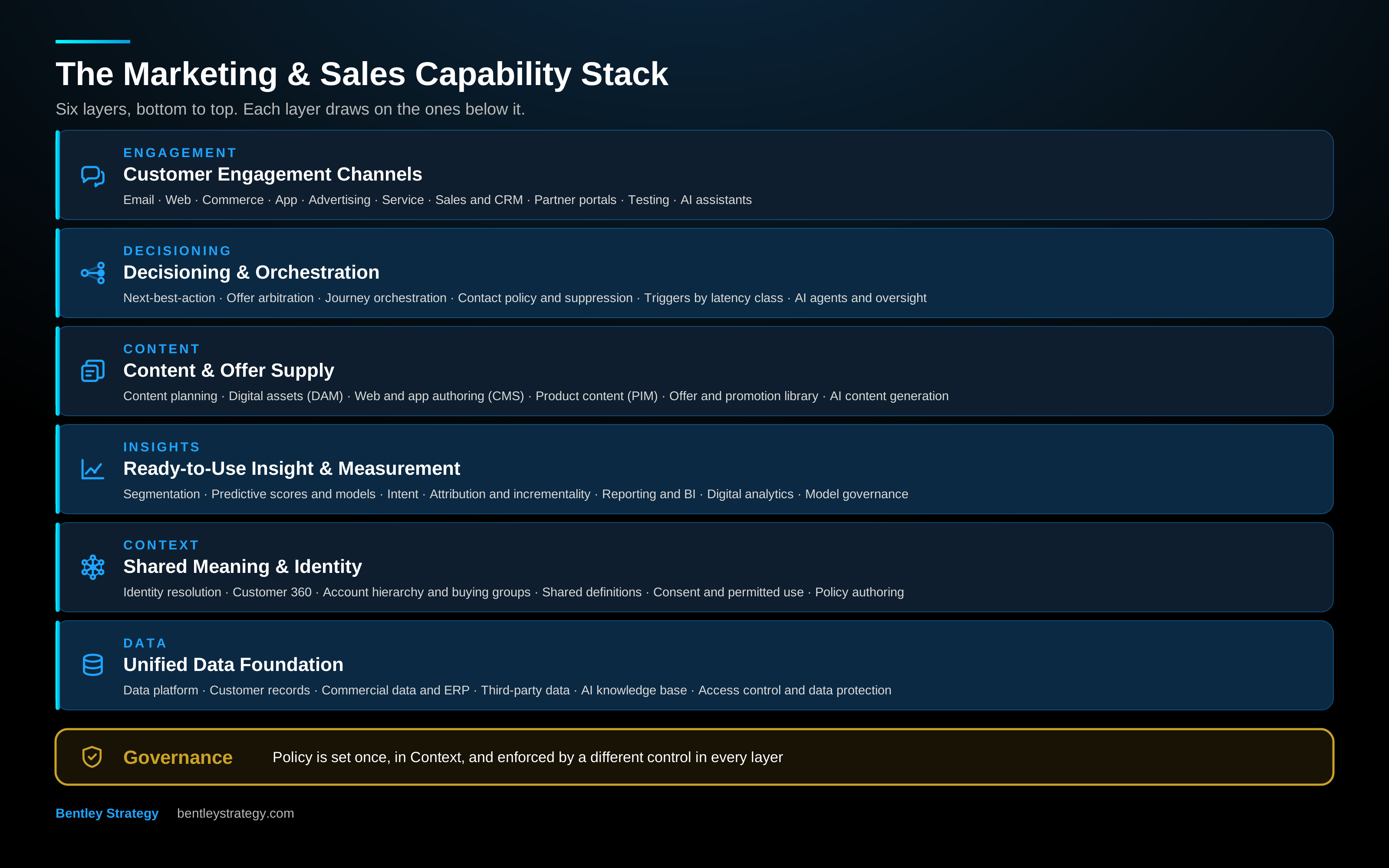
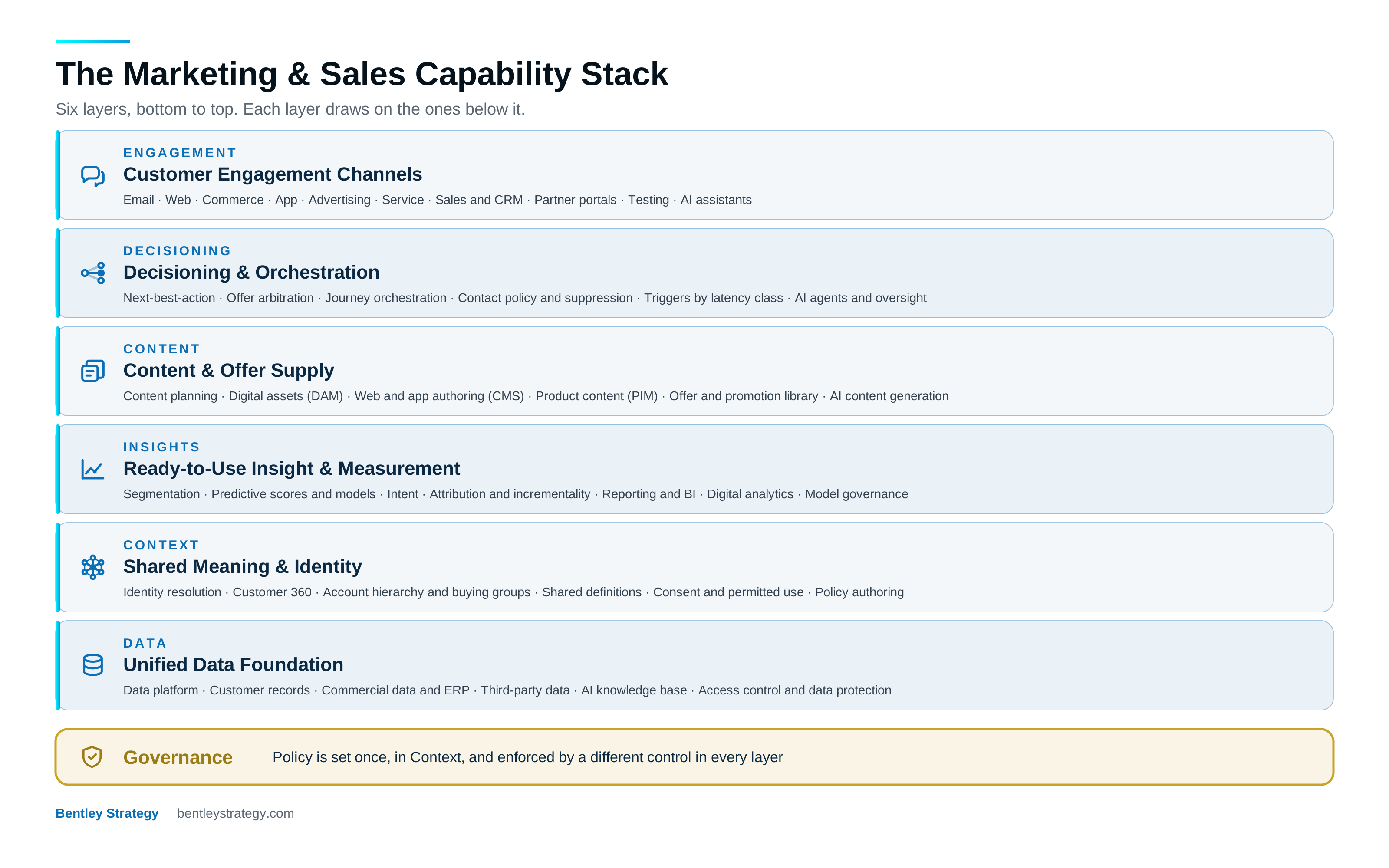
The Marketing & Sales Capability Stack: six layers from Data at the bottom to Engagement at the top, with governance running across all of them.

Marketing technology is a system. Few companies run it as one.

The system is too big for any one person to know. Decisions land one at a time, and in many companies no one is accountable for the whole.

Demonstrating ROI from marketing technology is among the weakest capabilities marketing leaders report, and fewer than one in three companies integrate all of their customer touchpoints. A shared set of words, so marketing, data, technology, sales and finance can point at the same thing, is where the fix starts.

Source: The CMO Survey, 35th edition, 2026.

The whole stack on one page.

The Marketing & Sales Capability Stack is a marketing technology reference architecture: a six-layer capability framework that any martech stack, vendor or internal team can be placed against.

The Marketing & Sales Capability Stack

Each layer draws on the ones below it. Open a layer for the job it does, the question that shows how it is doing, and example capabilities.

Engagement

Customer Engagement Channels

Email · Web · Commerce · App · Advertising · Service · Sales and CRM · Partner portals · Testing · AI assistants
More detailLess

Carry the decision out where the customer is, the sales call included, and record what happened.

The question: Does what happens in each channel, the sales call included, get written back?

Example capabilities

  • Campaign delivery: marketing automation, email, SMS and direct mail.
  • Sales channels: field sales, inside sales and the sales CRM.
  • Partner portals and B2B commerce, including reorder and contract pricing.
  • Website, app, advertising and AI assistants.
Decisioning

Decisioning & Orchestration

Next-best-action · Offer arbitration · Journey orchestration · Contact policy and suppression · Triggers by latency class · AI agents and oversight
More detailLess

Choose what happens next for each customer or account, so the channels act as one.

The question: When two campaigns want the same customer, what decides?

Example capabilities

  • Next-best-action and offer arbitration: rank the eligible options and pick the winner.
  • Journey logic: sequences that respond to what a customer or account does.
  • Contact policy and suppression: who may be contacted, how often, and who is excluded.
  • AI agents, with guardrails and an audit trail.
Content

Content & Offer Supply

Content planning · Digital assets (DAM) · Web and app authoring (CMS) · Product content (PIM) · Offer and promotion library · AI content generation
More detailLess

Hold everything the company might show or offer, in a form that can be reused rather than rebuilt.

The question: When we launch something new, how much is built from scratch?

Example capabilities

  • Digital asset library (DAM): approved images, video and brand content.
  • Web and app authoring (CMS): where pages and modular content are published.
  • Product content (PIM): descriptions and specifications, governed once and used everywhere.
  • Offer and promotion library, each offer with its eligibility and value.
Insights

Ready-to-Use Insight & Measurement

Segmentation · Predictive scores and models · Intent · Attribution and incrementality · Reporting and BI · Digital analytics · Model governance
More detailLess

Turn raw records into something usable: audiences, scores, accounts in market, and what drove results.

The question: Can a marketer build an audience and see what last quarter’s spend produced without filing a ticket?

Example capabilities

  • Segmentation and audiences, refreshed on a stated schedule.
  • Intent and account scoring: evidence that an account is in market.
  • Predictive scores: propensity, churn risk and lifetime value.
  • Attribution and incrementality, including holdout testing.
Context

Shared Meaning & Identity

Identity resolution · Customer 360 · Account hierarchy and buying groups · Shared definitions · Consent and permitted use · Policy authoring
More detailLess

Recognize that the website visitor, the email subscriber and the person on the sales call are the same human, and agree on what the words mean.

The question: If three teams count our customers, do they get the same number?

Example capabilities

  • Identity resolution: matching emails, phones, devices and accounts to one person or company.
  • Account hierarchy and buying groups: tying contacts to the right parent account.
  • Shared definitions for customer, active, churned, lead and revenue.
  • Consent and permitted use, and where policy is written.
Data

Unified Data Foundation

Data platform · Customer records · Commercial data and ERP · Third-party data · AI knowledge base · Access control and data protection
More detailLess

Store what the company knows about each customer and prospect. It is the company’s long-term memory.

The question: Where does our customer and commercial data live, ERP included, and who owns it?

Example capabilities

  • Data platform: the warehouse or lakehouse where records are consolidated.
  • ERP and commercial data: orders, pricing, inventory and contracts.
  • Third-party data: firmographics and market signals from outside the company.
  • Access control and data protection: who may read what.
Governance Policy is set once, in Context, and enforced by a different control in every layer

Bentley Strategy   bentleystrategy.com

Put it on the screen in your next vendor meeting. Point at a layer and ask which job the product does for you. Send it to the colleague who sees the stack from another seat. It works because every capability has one home.

Printable framework Framework worksheet for organizing your stack

Three ways to put the framework to work.

Organize vendors and internal capabilities quickly.

Read moreRead less

Sort by the job a product does, not the category it is sold under. Two vendors from different categories can sound almost the same. Here are two pitches, read aloud. Both are invented composites, not real products.

Invented example

Vendor A, a campaign automation platform

“We unify your customer data and deliver personalized, real-time journeys across every channel.”
Layers
Decisioning and Engagement.
The job
It runs journey logic and sends the message.
What it does not do
Resolve identity across your systems, hold the customer record, or build the models behind its scores.

Invented example

Vendor B, a customer data platform

“We unify your customer data and activate personalized, real-time experiences across every channel.”
Layers
Data, Insights and Engagement.
The job
It keeps a scoped copy of the record, builds audiences, and syncs them to the channels.
What it does not do
Decide which offer wins, enforce contact policy across channels, or send the message.

Identify under-utilized data and technology.

Read moreRead less

The capability that is easiest to add is the one already in the contract. Scoring built into the automation platform, destinations set up in the customer data platform, journey tools used as a better send button. These sit switched off in stacks every week. Nobody decided to leave them off. Nobody noticed.

Identify the gaps holding your strategy back.

Read moreRead less

Stacks grow around the problem of the day, so a few capabilities rarely make the list. Outside enrichment and intent data. A connected layer where one place decides and the channels carry it out. Write-back from channels and from sales. Account hierarchy and buying groups. Each changes what the rest of the stack can do.

Take it with you.

The Field Guide is a PDF you can forward to a colleague or present from without building slides.

  • The full deck, 34 slides.
  • The terms you will hear in the next vendor meeting, defined plainly.
  • The one-page framework, printable.

Want to talk it through? Thirty minutes by video, without the bias of a vendor or agency trying to sell you the next project.

Book a free 30-minute consult

The Capability Stack Field Guide

Your download starts right away. I may follow up by email. Privacy policy.

Your download has started.

If it did not start, use the button below.

Download the Field Guide

Print-friendly version. Same guide, light pages, easier on your printer.

Book a call